Thursday, June 24, 2010

Types of Angles


Studying about angles are very interesting since it comes with diagrams and more easy to explain and learn as well. let me show you few types of angles with the diagram..

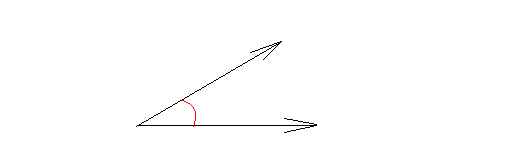
Acute angle:

An angle whose measure is less than 90 degrees. The following is an acute angle.Acute-angle-image
Right angle:

An angle whose measure is 90 degrees. The following is a right angle.
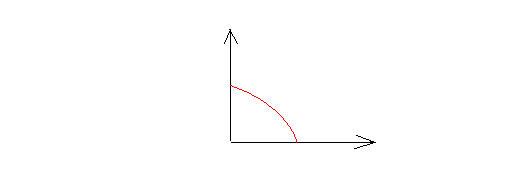
Right-angle-image

Obtuse angle:

An angle whose measure is bigger than 90 degrees but less than 180 degrees. Thus, it is between 90 degrees and 180 degrees. The following is an obtuse angle.

Obtuse-angle-image

Straight angle

An angle whose measure is 180 degrees.Thus, a straight angle look like a straight line. The following is a straight angle.
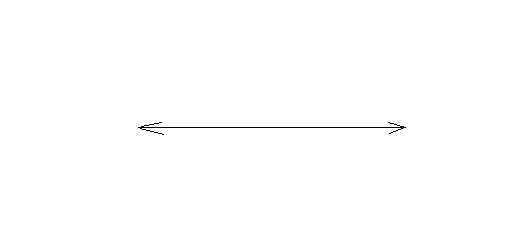
Straight-angle-image

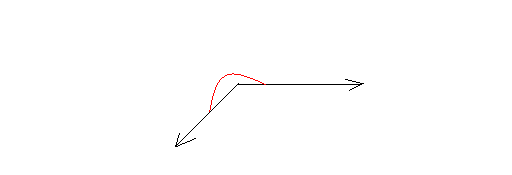
Reflex angle:

An angle whose measure is bigger than 180 degrees but less than 360 degrees.The following is a reflex angle.Reflex-angle-image
Adjacent angles:

Angle with a common vertex and one common side. <1 src="http://www.basic-mathematics.com/images/Adjacentangle.gif" border="0" alt="Adjacent-angle-image">

Complementary angles:

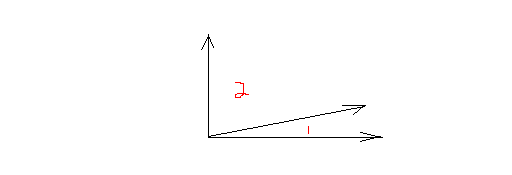
Two angles whose measures add to 90 degrees. Angle 1 and angle 2 are complementary angles because together they form a right angle.

Note that angle 1 and angle 2 do not have to be adjacent to be complementary as long as they add up to 90 degrees
complemenetary-angle-image

Supplementary angles:

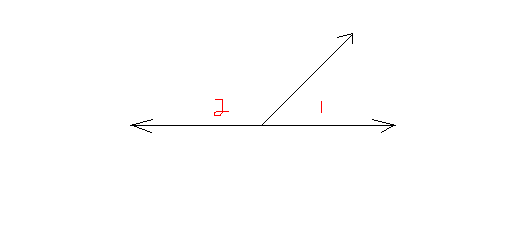
Two angles whose measures add to 180 degrees. The following are supplementary angles.
Supplementary-angle-image
Vertical angles:

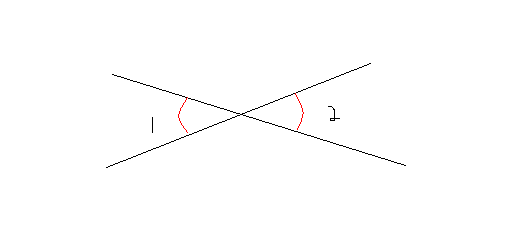
Angles that have a common vertex and whose sides are formed by the same lines. The following(angle 1 and angle 2) are vertical angles.
Verical-angle-image

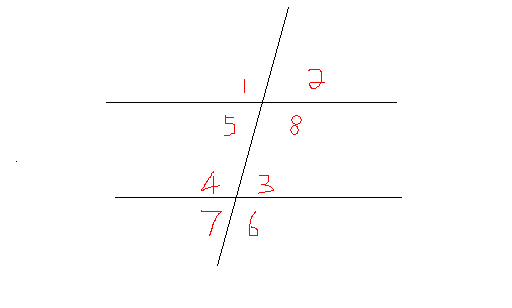
When two parallel lines are crossed by a third line(Transversal), 8 angles are formed. Take a look at the following figure
Transverlines-image

Angles 3,4,5,8 are interior angles

Angles 1,2,6,7 are exterior angles

Alternate interior angles:

Pairs of interior angles on opposite sides of the transversal.

For instance, angle 3 and angle 5 are alternate interior angles. Angle 4 and angle 8 are also alternate interior angles.

Alternate exterior angles:

Pairs of exterior angles on opposite sides of the transversal.

Angle 2 and angle 7 are alternate exterior angles.

Corresponding angles:

Pairs of angles that are in similar positions.

Angle 3 and angle 2 are corresponding angles.

Angle 5 and angle 7 are corresponding angles

Example Problems for Word Problems

Introduction to word problems:

In mathematics education, the term word problem is often used to refer to any mathematical exercise where significant background information on the problem is presented as text rather than in mathematical notation. As word problems often involve a narrative of some sort, they are also referred to as story problems and may vary in the amount of language used.
Problems on Word Problems
Hear by ... let me show your a example on word problems ... so that it is little easy for you to understand better.
Example:
The sum of thrice a number plus 60 is 330. Determine the number.
Solution:
The word is means equals. The word and means plus.
Rewrite the word problem
the sum of thrice a number and 60 equals 330.
Write the problem into an equation.
3M + 60 = 330
Solve the above equation using the variable.
3M + 60 = 330 (Given Equation)
3M + 60 – 60 = 330 - 60 (Both side subtracted by – 60, we get)
3M = 270
M = 90 (Both sides Divided by 3, we get the result)
Solution to the given word Problem is 90.
This was just a sample problems on word.. Keep reading and leave your valuable comments.. and let me know if you are particular in learning any topic in math, i will be able to help you with that all.

Tuesday, May 25, 2010

Polynomial Matrices

In this lesson let try to understand more on A polynomial matrices or matrix polynomial is a matrix whose elements are univariate or multivariate polynomials.

Properties of Polynomial Matrices
Following are the properties of polynomial Matrics and its functions
  • A polynomial matrix in excess of a field with determinant equivalent to a non-zero constant is called uni modular, and have an inverse, which is also a polynomial matrix.
  • Note, that the simply scalar uni modular polynomials are polynomials of degree 0 - nonzero constants, for the reason that an inverse of an arbitrary polynomial of high degree is a rational function.
  • The roots of a polynomial matrix in excess of the complex numbers are the points in the complex plane wherever the matrix loses rank.
Example 1
An example the 3x3 polynomial matrices


+
This is how we solve problems on plynomial Matrices. Hope this lesson is more useful to you. Keep reading.... and leave your comments if you wish to share anything to me . May be in the following lesson we shall dicuss on Various topics involved in the algebra ii

Polynomials and polynomial functions


Introduction polynomials and polynomial functions:
Hear is and brief introduction on Polynomials and Polynomial Functions.An Algebraic expression of the form axn is called a monomial in x, where a is a known number, x is a variable and n is a non-negative integer. The coefficient of yn and n has a number, the degree of the monomial. For example, 7x3 is a monomial in x of degree 3 and 7 is the coefficient of x3. The total value of 2 monomial is known as a binomial and the sum of three monomial is called a trinomial. For example, 2x3 + 3x is a binomial and 2x5 – 3x2 + 3 is a trinomial. The total of a finite number of monomial in y is known as a polynomial in y.

Polynomial and polynomials functions exercise Problems

Following is the sample exercise on polynomial and polynomials function.

The polynomial with its functions are used to solve the following examples:
In each of the problems 1 to 3, find the subtraction and write it in the standard form :
1. (x3 + 5x2 – 10x + 6) – (2x3 – 3x – 4)
2. (x4 – 3x2 + 7x – 8) – (2x4 + x2 + 3x)
3. (3x5 – 5x2 + 4x – 7) – (1– 2x + 3x2 x3)
This is how we learn on polynomials and polynomial functions. May be in the following lesson i will try to help you more on dividing polynomials by polynomials.

Thursday, May 20, 2010

Linear Programming Problem and its Mathematical Formulation

In this lesson we will briefly come to an conclusion on Linear Programming problems and its Mathematical

There are mainly four steps in the mathematical formulation of linear programming problem as a mathematical model. We will discuss formulation of those problems which involve only two variable

Let x be the number of tables and y be the number of chairs that the dealer buys.
Obviously, x and y must be non-negative, i.e.,


The dealer is constrained by the maximum amount he can invest (Here it is
Rs 50,000) and by the maximum number of items he can store (Here it is 60).
Stated mathematically,
2500x + 500y ≤ 50000 (investment constraint)
or 5x + y ≤ 100 ... (3)
and x + y ≤ 60 (storage constraint) ... (4)

Elementary Operation (Transformation) of a Matrix

I will help you understand the major three operations on Elementary Operation (Transformation) of a Matrix.

There are six operations (transformations) on a matrix, three of which are due to rows
and three due to columns, which are known as elementary operations or
transformations.


(i) The interchange of any two rows or two columns is an elementary operation. Symbolically the interchange of ith and jth rows is denoted by Ri ↔ Rj and interchange of ith and jth column is
denoted by Ci ↔ Cj. Solving matrices can be simplified with these operations.

(ii) The multiplication of the elements of any row or column by a non zero
number is another operation. Symbolically, the multiplication of each element of the ith row by k,
where k ≠ 0 is denoted by Ri → k Ri. The corresponding column operation is denoted by Ci →kCi

(iii) The addition to the elements of any row or column, the corresponding
elements of any other row or column multiplied by any non zero number.
Symbolically, the addition to the elements of ith row, the corresponding elements
of jth row multiplied by k is denoted by Ri → Ri + kRj.

These operations are used in solving matrices.

How to Solve Matrices Problems

I am showing a few Solved Matrices Problems
Problem - 1 - If a matrix has 8 elements, what are the possible orders it can have?
Solution - We know that if a matrix is of order m × n, it has mn elements. Thus, to find all possible orders of a matrix with 8 elements, we will find all ordered pairs of natural numbers, whose product is 8. Thus, all possible ordered pairs are (1, 8), (8, 1), (4, 2), (2, 4) Hence, possible orders are 1 × 8, 8 ×1, 4 × 2, 2 × 4
Problem 2 - Consider the following information regarding the number of men and women workers in three factories I, II and III
Men workers Women workers
I 30 25
II 25 31
III 27 26
Represent the above information in the form of a 3 × 2 matrix. What does the entry
in the third row and second column represent?

Solution -
The information is represented in the form of a 3 × 2 matrix as follows:
The entry in the third row and second column represents the number of women
workers in factory III.

Will be back with more matrices problems